
Benepets does something no company benefit has ever done: it takes care of what takes care of you.
You work for a company that finally “gets you.’
Benepets is a Delaware PBC that turns employer benefits into pet-as-dependent stipends & blockchain-verified animal rescue funding.
*
Benepets is a Delaware PBC that turns employer benefits into pet-as-dependent stipends & blockchain-verified animal rescue funding. *
So, what is Benepets?
A Delaware Public Benefit Corporation and HR-fintech-for-good platform that enables pet care as a formal employee benefit, with blockchain-verified animal rescue funding.

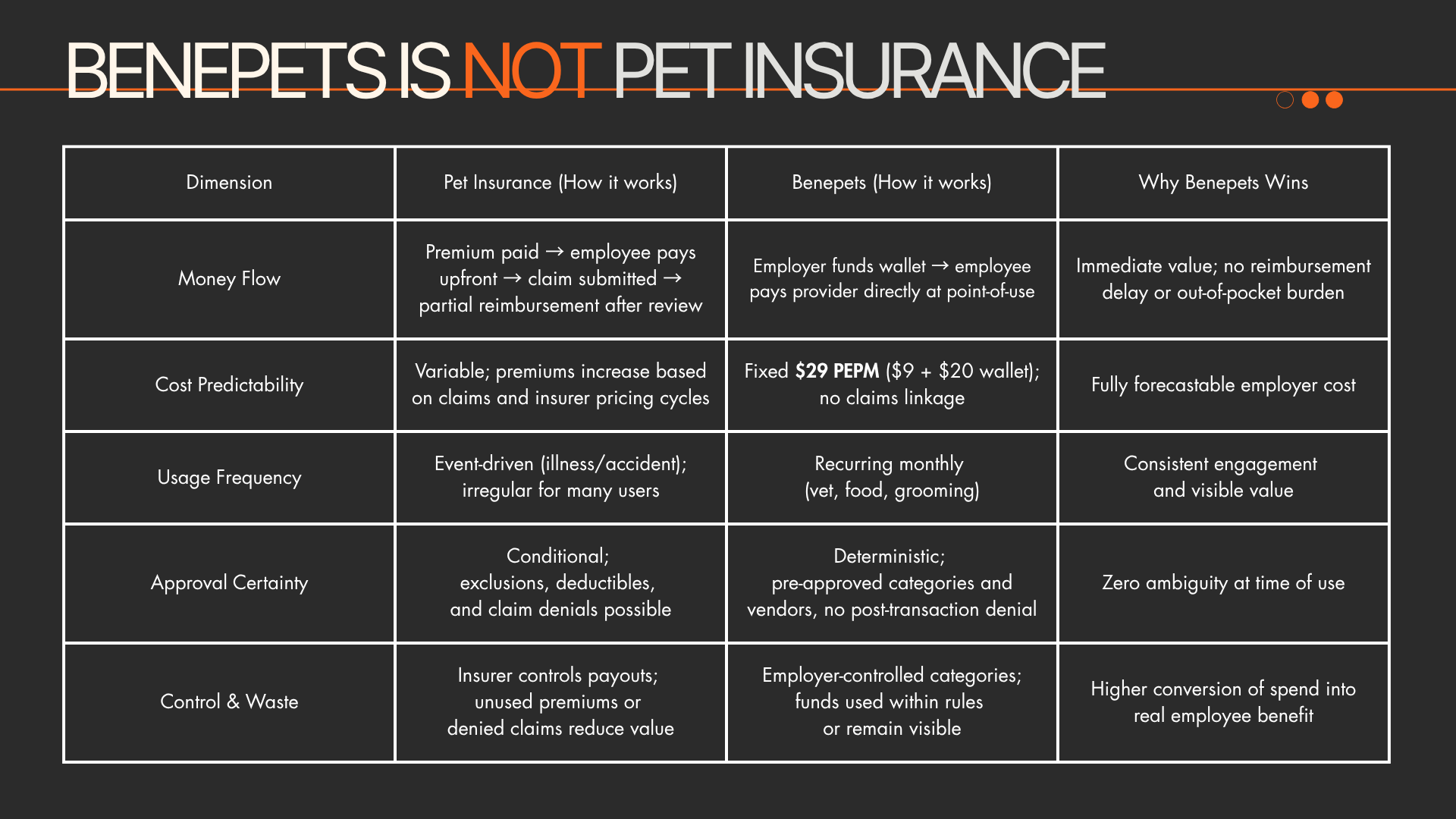
Benepets is NOT pet insurance

Every company says it cares for their people. Benepets is the benefits platform that can prove it. We built an infrastructure that turns HR benefits into dual-ROI = internal return (employee retention and performance) + external return (social impact).
Here’s how it works: Employees get a Pet Wallet, with monthly credits for the vet, food, and routine care. They use it for what matters most at home: their pets and their peace of mind.
Every pet cared for funds a pet saved.
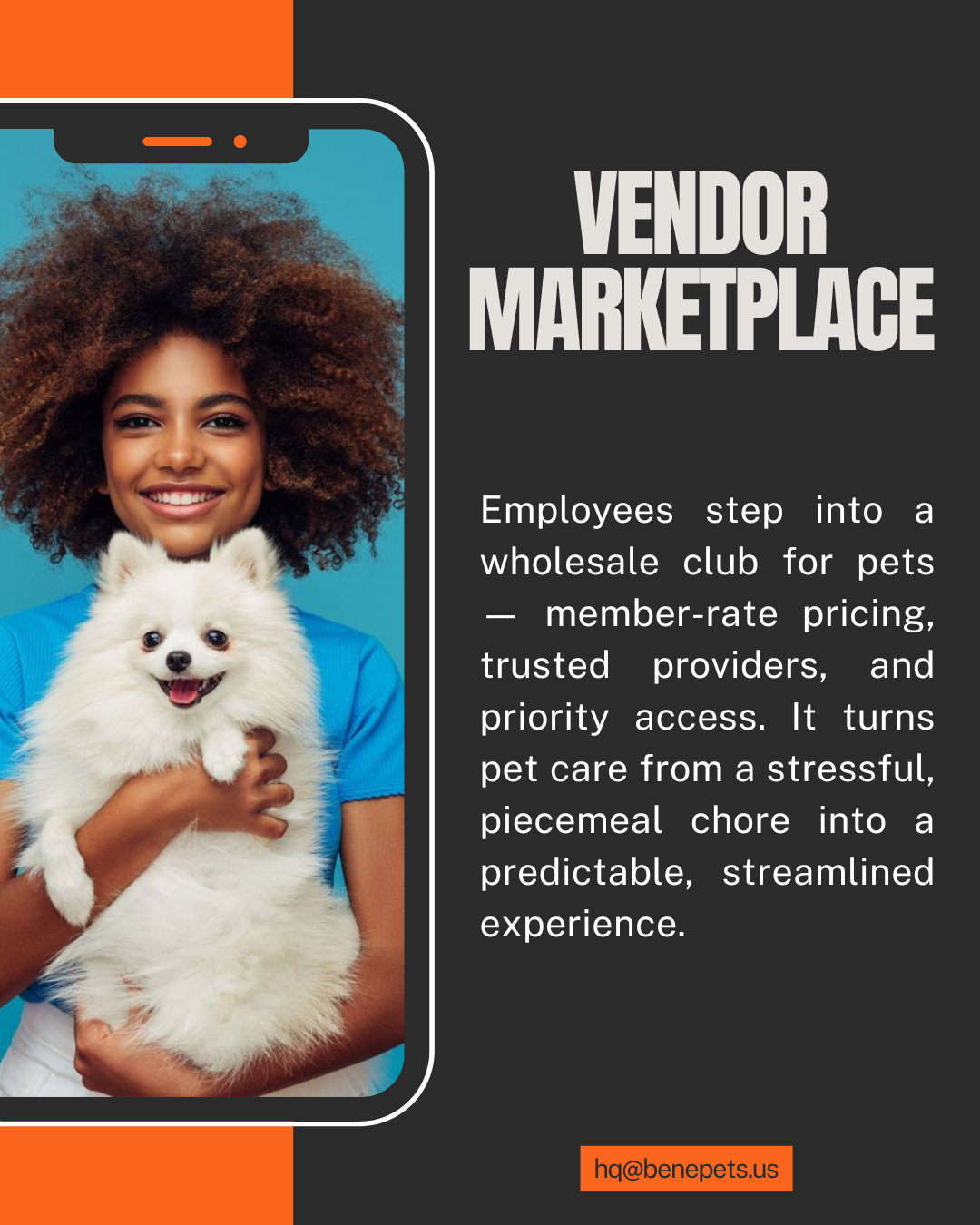
And with Benepets’ Costco of Pet Care pricing, pet wallet credits stretch further, so every employer dollar is worth twice.
Pets are the new dependents.
50% of Europe’s households are pet owners, double the share of parents with children. In Japan and South Korea, pets outnumber children.
In North America, 70%+ of the workforce are pet owners.
Pet expenses rank among the top 3 stressors (after housing and healthcare), and 1 in 7 pet owners experience pet poverty.
For Employees, it does something no company benefit has ever done: it takes care of what takes care of you.
You work for a company that finally “gets you.”
For employers, it’s a talent, engagement, and retention weapon because it cuts straight into the real pain points across industries—workload, stress, exhaustion—that salary cannot buffer. A benefit that eases the cost of caring for a pet says, “We see what keeps you going.” It reaches the workforce in a way no insurance perk or gym pass can touch.
For finance, it pays for itself and ticks every box: cost certainty, operational efficiency, value preservation, and proof of utilization.
For rescues, it is survival, a stable funding for shelters.
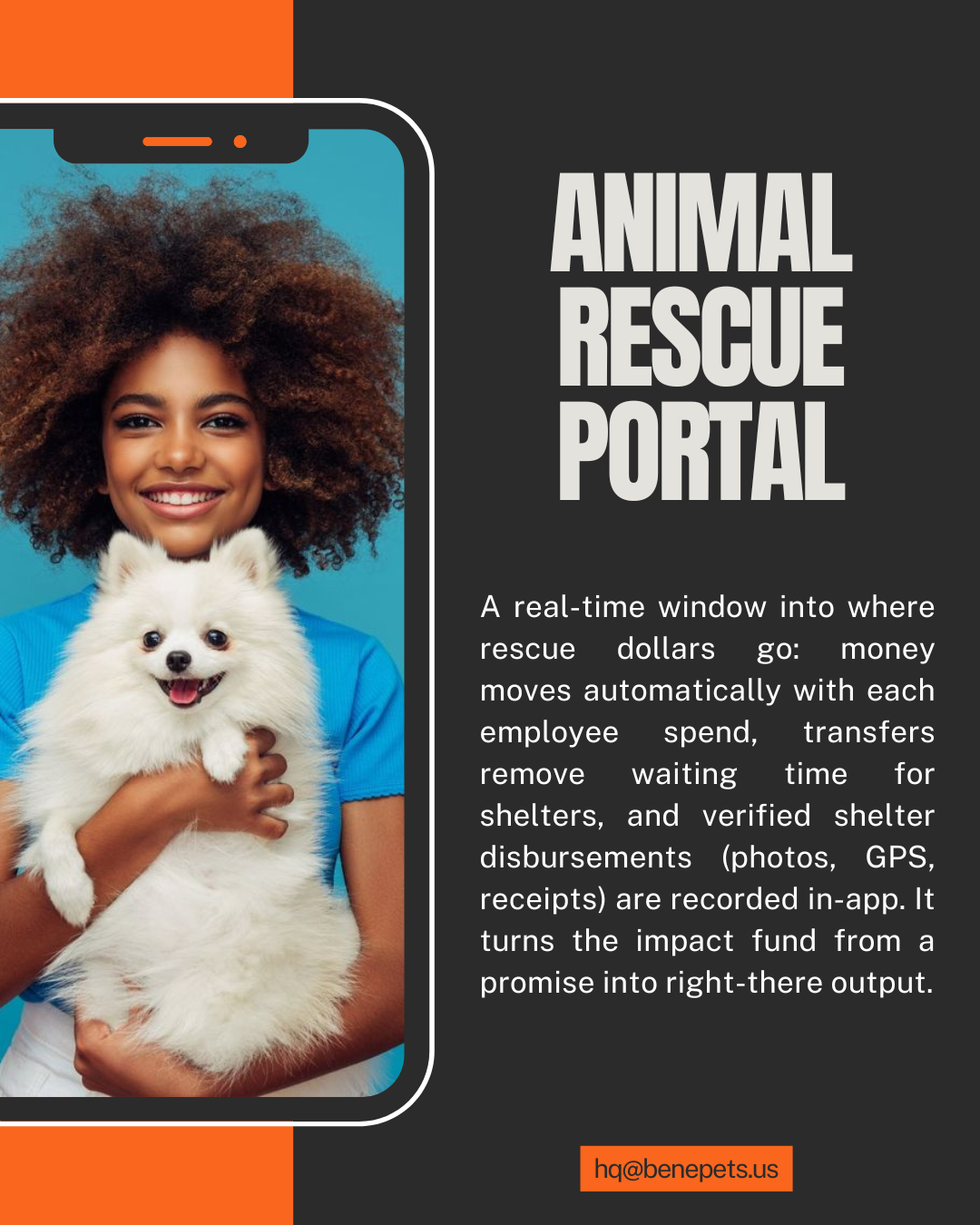
7% of the total revenue flows to the Benepets foundation, verified within 30 days, and visible to every stakeholder.
So, what is Benepets? It is the world’s first and only Benefits HR-Fintech-For-Good Platform. Care sustains Loyalty. Loyalty sustains growth.


For every $1 deployed, employers see $1.1–$3.2 workforce return + continuous ESG contribution built into spend
The Benefits of Benepets, QuantifiedThe Benepets Foundation is not a charity; it is the blockchain-verified engine that turns Benepets’ commercial activity into social contribution, with 7% of total revenue directed to animal rescue funding.
The Benefits of Benepets, QuantifiedBenepets is the Costco of Pet Care, stretching a $240 wallet to roughly $300 in value—about 25% more care for the same dollars.
The Benefits of Benepets, QuantifiedBenepets is a life management platform for pet ownership.
Because pet care is too costly, too frequent, and too complex to manage without one.
Cost: Full-stack pet care runs $1.3K–$4.0K/year; $20K–$60K+ over a 15-year lifetime.
Frequency: 1–2+ vet visits per year (~69% annual clinic usage), plus continuous monthly spend on food, supplies, and routine care (4–6 X per year).
Fragmentation: Care spans ≥5 provider types: 34,000+ veterinary practices, specialty hospitals, grooming, food/supply retail, and boarding/daycare.            Source: AVMA; APPA; Synchrony Lifetime of Care Study; U.S. Census Bureau
The Benefits of Benepets, Quantified-

For Employers
For every $1 deployed, employers see $2-5 in HR and CSR/ESG return within 12 months.
Pain Point: Corporate benefits center on children and spouses. It misses the parallel world sitting right next to it: The pet is a child and pet care mirrors dependent care. There is a mismatch between how employees live and how benefits still assume they live — a blind spot tied to cost, productivity, and retention.
-

For Employees
BENEPETS IS THE COSTCO OF PET CARE, stretching a $240 wallet to roughly $300 in value — about 25% more care for the same dollars.
Pain Point: Pet care costs climb 6–8%/year, rivaling child care and outpacing wage growth. There’s guilt when care is delayed or downgraded, and distress when affordability blocks it — a grinding anxiety of keeping a dependent healthy in a system that offers no safety net for it.
-
For the Foundation
THE FOUNDATION IS NOT A CHARITY; it is the blockchain-verified engine that turns Benepets’ commercial activity into social contribution, with 7% of the total recurring revenue directed to animal rescue funding.
Pain Point: 6 million of the 70 million stray animals enter U.S. shelters each year. Yet rescues run on thin reserves as the pet industry generates billions — cut off from the very economy that profits from pets.
Dogs make people’s lives better.They stabilize, ground, and transform us. If that is true, then workplaces should stop pretending pets are irrelevant.
Behind Benepets

Ian Jeon
Founder & Chief StewardIan built companies for 25 years in transportation, food service, and cross-national education across South Korea, the Philippines, and China. She approaches ventures with a builder’s discipline: clear models, clean systems, and structures that can scale without drama.
She is completing her Doctorate in Business Administration in Paris, and Benepets grew out of the thinking she has done there. The project began with a simple question: how to build a company that delivers commercial strength and social contribution without splitting the two. That question shaped the platform’s structure and the financial loop Benepets runs on today.

Founding AdvisorWeng Manalaysay
Weng brings more than 2 decades of senior people-leadership experience across global retail, fintech, and technology platforms in the Philippines. She has led country-level human resources functions at organizations such as IKEA, Grab, Tonik, and PayMongo, working closely with executive teams as companies scaled workforces, benefits structures, and employee support systems.
Her background aligns closely with Benepets’ focus on employer-delivered benefits, operational rigor, and people-first design. Having built and governed employee programs within highly regulated and fast-growing environments, Weng contributes practical judgment on how benefit platforms are evaluated, adopted, and sustained inside real organizations. As a Founding Advisor, she supports Benepets at the intersection of HR leadership, employer readiness, and institutional decision-making.

One app. Multiple ways to fund pet care.
01 Employer-funded
Company pays the subscription and funds the Pet Wallet.
Employees can add their own top-ups.
02
Employee-funded
Individual pays the subscription and funds the Pet Wallet.
03
Employer + Employee Co-Funded
Company covers access.
Employee funds the Pet Wallet.
04
Government-to-Citizen (G2C)
Government funds both access and the Pet Wallet for eligible groups.
Benepets: A Life Management Platform for Pet Ownership
Pet ownership has become one of the most structured obligations in modern life. It arrives every month in the form of food, routine care, and maintenance, and without warning in the form of illness or emergency. The spending is continuous. The costs shift with inflation. Care is spread across clinics, retailers, groomers, and pharmacies. Records are kept in fragments. Each interaction requires a fresh decision on where to go, what to buy, how much to spend.
Emerging is a pattern that feels familiar: a system in practice, without a system in place.
The consequences are consistent. Costs fluctuate without constraint, shaped by timing rather than planning. Time disperses across bookings, purchases, and follow-ups. Decisions accumulate, small on their own, constant in total. Pet ownership becomes less a singular responsibility than a series of loosely connected tasks, repeated over time.
Other parts of life have long since been organized differently. Healthcare operates through structured funding, defined provider networks, and recorded histories. Payroll allocates resources, governs how they are used, and produces a continuous record of activity. In both cases, complexity is absorbed into a system that manages flow.
Pet care has remained outside that structure. Benepets introduces one.
It begins with funding, placed into a dedicated wallet and reserved for pet care. Access is directed through a network of clinics, food providers, and services within a defined pricing environment. Payments, bookings, and purchases move through a single channel. Each transaction is recorded, building a continuous record of spending, usage, and care, alongside consolidated health information. A portion of platform revenue is allocated to animal rescue, tied directly to activity and made visible.
For employers, this structure brings a category of personal responsibility into the realm of managed benefits, with defined funding and observable use. For individuals, it reduces the need for constant coordination, gathering money, services, and records into a single flow. For providers, it concentrates demand and stabilizes payment. For public systems, it directs spending into formal networks while embedding a mechanism for animal welfare.
Benepets, beneficially, manages how money is allocated, where care is accessed, how actions are executed, and how history is carried forward.